
Lessons from Fiji
A case study in real-world demographic restoration

I recently returned from a family holiday in Fiji, where I took the opportunity to learn a bit more about that county’s fraught history of mass migration, ethnic conflict, military coups, and demographic shifts.
Fiji’s experience serves as both a warning to countries like New Zealand about the consequences of mass migration and ethnic replacement, and a learning opportunity about the types of reforms that can reverse it.
Fiji, British Colonialism and the “Girmit” story
Fiji is an archipelago that lies approximately 2000 kilometres North of New Zealand. It is believed to have been first colonised by the Lapita people some 3000-3500 years ago. Then there was ongoing contact with, and some settlement and assimilation from Melanesian and Polynesian peoples, giving rise to the Indigenous Fijian people we know today.
James Cook sighted the Islands in 1774 but didn’t establish relations. Following that, European whalers, traders, convicts and missionaries began arriving more regularly in the early 1800s. A permanent methodist mission was established in 1835. By the mid-1800s Fiji was tied into European trading networks. After a chaotic period of settlement, tribal conflict, and a failed attempt to establish a unified Fijian Kingdom, Fiji’s Chiefs formally ceded control to the British in 1874, persuaded, in part, by British assurances they would protect the Indigenous Fijians from settler takeover and loss of land.
The British DID protect communal ownership of Fijian land and allowed them to continue their traditional village way of life rather than absorb them into the settler economy and society. Fiji now has the most extensive system of indigenous land protection in the world - 90% of Fijian land remains in perpetual communal indigenous ownership, which agricultural and commercial interests from outside must lease to use. Fiji’s traditional villages and way of life remain largely intact.
A colonial plantation economy was built up around the Fijians, based around sugar plantations and a few other crops. The British also built ports, roads, infrastructure, government administration and linked Fiji into the commonwealth economy through trade. Because the British had agreed to protect the indigenous Fijian’s way of life, they had to turn elsewhere for the labour to work the plantations. Around 60,000 indentured labourers from India were brought to Fiji from 1879-1916 under the “Girmit” system (“Girmit” being the Fijian-Hindu pronunciation of “agreement”). The combination of protecting Indigenous Fijian society, while importing a large number of Indian labourers created an ethnically segregated country.
Under the Girmit system Indians had to work 5 years of compulsory labour on the plantations, in harsh conditions some historians have compared to slavery in America’s south. They then could be employed in paid work for 5 years, before having the option to return to India. The system officially ended in 1920 after coming under criticism internationally, particularly from India. However, many Indians stayed on, working in agriculture and commerce. The Indian population grew to roughly equal the Indigenous Fijian population by the 1950s, at times exceeding it, and the Indians became dominant commercially and in the professions.
Fiji gained formal independence from Britain in 1970, driven mainly by international trends toward decolonisation. The transition happened peacefully. A new constitution was developed that tried to balance Indigenous Fijian political control, chiefly authority, Indian representation, and Westminster democracy. However, politics quickly divided along ethnic lines. In 1987 an Indian dominated government was elected, sparking fears of permanent displacement of indigenous Fijians. In response, a lieutenant-colonel named Sitiveni Rabuka staged two military coups to protect Fijian political supremacy, indigenous land rights, Chiefly authority and Christianity. In 1990 a new constitution was passed favouring indigenous political representation and control of the public service, which was viewed by many Indians as discriminatory.
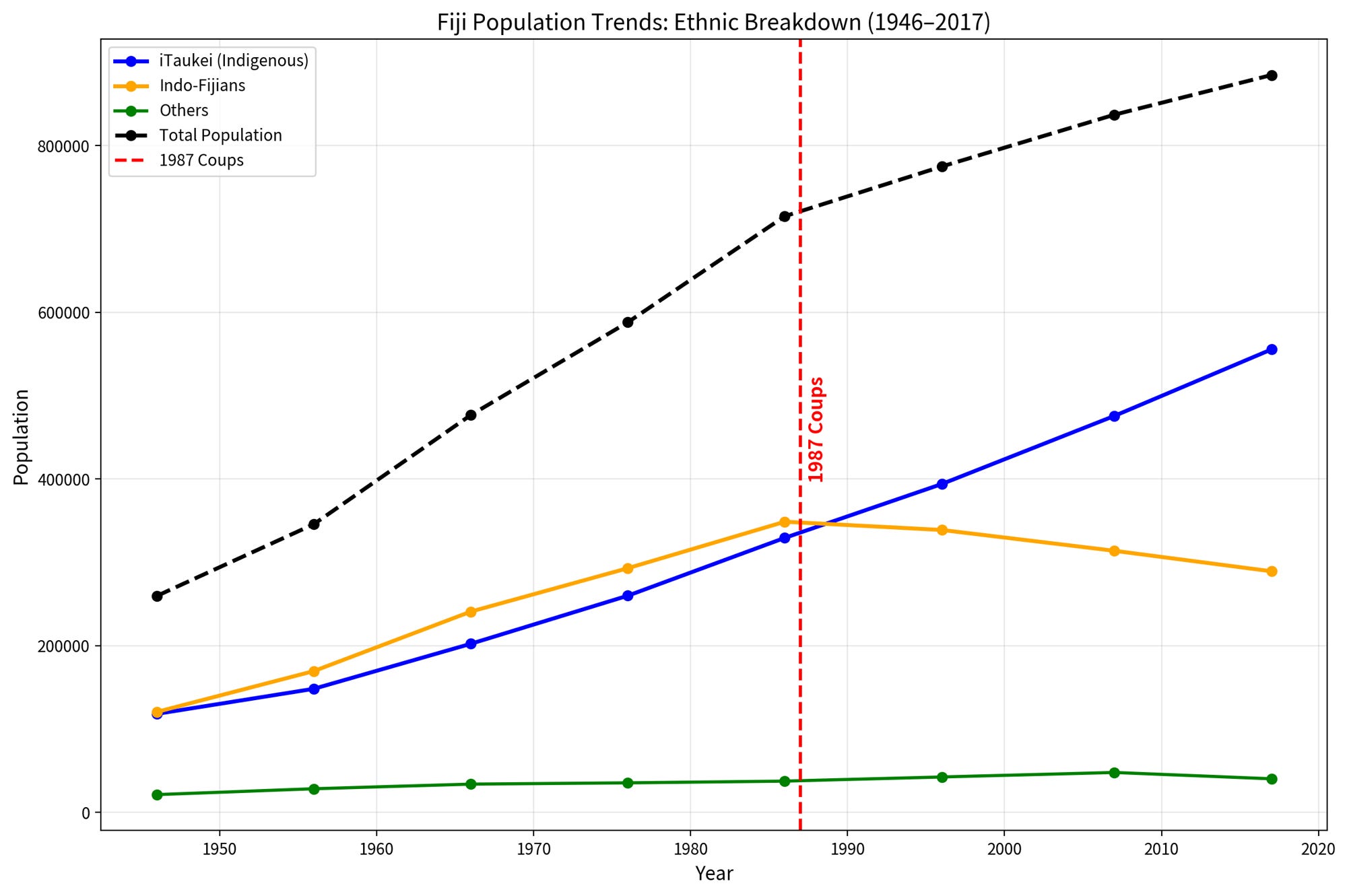
Many Indians emigrated as a result of the coups, the constitutional changes and the other policies that were implemented. As a result, the Indian population of Fiji has fallen from around 50%, to only 30% now, while Indigenous Fijians have risen from just under half, to around 65%, and these demographic trajectories look set to continue in the immediate future. The political upheavals were no doubt problematic and accompanied by racism and discrimination against the Indian population, but Fiji will remain Fijian for the foreseeable future.
What policies were implemented post-coup?
Entrenchment of Indigenous Fijian Parliamentary Supremacy
The 1990 constitution explicitly aimed to protect Indigenous Fijian “paramountcy”. It reserved 37 of Parliament’s 70 seats for Indigenous Fijians, 27 for Indians and the rest for others, with ethnically segregated voter rolls. This guaranteed an Indigenous Fijian majority. The office of Prime Minister was also reserved only for Indigenous Fijians, and the President had to be appointed by the Great Council of Chiefs.
Many other constitutional protections for Indigenous Fijian rights were also entrenched, and could only be changed through parliamentary supermajorities and approval from the Great Council of Chiefs.
Ethnic favouritism of Indigenous Fijians in the public service
The 1990 Constitution and subsequent policies explicitly promoted Indigenous Fijians in the public service via affirmative action. This included preferences in recruitment, promotions, scholarships, and training to address perceived under-representation and protect indigenous interests. This resulted in around 70% of public service positions being filled by Indigenous Fijians, with Senior levels often 80–90%. The Police were around 65–75%, and Indigenous Fijians made up over 99% of military personnel.
Non-renewal of leases
Prior to the 1987 coups, Indigenous Fijian land was leased under the Agricultural Landlord and Tenant Act 1966/1976. It offered 30-year leases (with rent based on unimproved capital value, reviewed every 5 years) but no automatic right to renewal. This gave tenants some security during the lease term but left them vulnerable at expiry. Many Indo-Fijian families had lived and farmed under this arrangement, often building homes on the land.
After the 1987 coups, non-renewal of leases became a political weapon - leases began to expire en masse in the late 1990s and many indigenous leaders refused to renew or demanded much higher rents. The resulting renewal rates were very low - around 27-28%.
These low rates of renewal, coupled with politicians and indigenous leaders explicitly linking non-renewal to assertions of indigenous rights, created widespread uncertainty and fear of dispossession.
Ethnic violence, intimidation and discrimination
Although the coups themselves were bloodless, in their wake there were numerous attacks on Indian individuals, their property, temples and so on. They also faced harassment, racism and discrimination. This helped create a climate of fear and intimidation.
Effects on Indian emigration, population, and demographic changes
In the pre-coup period of 1978–1986, approximately 2,300 Fijians emigrated annually. In the post-coup environment, this more than doubled to around 5,000 per year, with about 90% of emigrants being Indians. The destinations were primarily Australia, New Zealand, Canada, and the US. Chain migration and family reunification accelerated the process.
By the early 2000s, estimates of total Indo-Fijian emigration since 1987 ranged from 50,000–80,000. Aside from emigrations, relatively lower birth rates also played a role.
At the 1986 census, Fiji’s population was 715,375, with approximately 329,305 Indigenous Fijians (46%), 348,704 Indians (48.7%), and 37,366 people of other ethnicities (~5.2%). As can be seen from the graph below, the coups and resulting changes to laws, policies and the general environment permanently altered the demographic trajectories of the various populations, ensuring Fiji remained Fijian.
Despite achieving many of their political aims, the coups and resulting ethnic politics also imposed significant costs on Fiji. Political instability, military intervention in civilian government, ethnic tension, capital flight, and the emigration of many skilled professionals weakened economic growth and institutional trust for decades and resulted in international isolation.
While Indigenous Fijians successfully preserved political supremacy and avoided becoming a minority in their own homeland, the broader result was a more fragile and ethnically segmented state.
Since Frank Bainimarama’s more recent 2006 coup, Fiji has reversed course somewhat, softening constitutional protections for Indigenous Fijian paramountcy. The 2013 Constitution replaced ethnic safeguards with a civic, non-racial framework: it introduced a common electoral roll, removed guaranteed indigenous dominance in key offices, abolished the Great Council of Chiefs’ formal role, and established a single “Fijian” national identity for all citizens. Affirmative action in the public service was also curtailed. However, these changes were made in an environment where an Indigenous Fijian demographic majority had already been secured in the medium term. Constitutional recognition of Indigenous Fijian customs, culture, and traditional leadership still remains, as does perpetual communal ownership of indigenous land.
Lessons from Fiji’s experience
Fiji and New Zealand are not identical cases. Fiji remained primarily an indigenous society throughout most of its modern history, while New Zealand developed primarily as a British settler state with Indigenous Māori as (effectively, but not formally) the junior partner. Also, in New Zealand British sovereignty and settlement was legitimated by the signing of the Treaty of Waitangi, and British settlers and Māori more or less regard one another as the nation’s founding peoples; whereas Fiji’s Indian population are not founding partners of the state and their presence in Fiji has never been viewed by Indigenous Fijians with the same sense of legitimacy. Nevertheless, Fiji’s experience demonstrates several important lessons relevant to New Zealand and other Western countries undergoing rapid demographic change.
Lesson 1: When a traditional population feels their majority, power, and status under threat from newcomers, it can cause ethnic conflict, violence, and political upheaval.
From the perspective of New Zealand and other Western countries currently undergoing a Great Replacement, this should be read as a warning - demographic change is not merely an economic or cultural issue: if left unmanaged, it can eventually destabilise the political foundations of a society.
Lesson 2: Demographic trajectories are shaped by a nation’s culture, institutions, and constitutional foundations, not just immigration policy.
Fiji demonstrates that immigration policy is not the only mechanism capable of altering the demographic trajectory of a country: constitutions, land ownership systems, affirmative action policies, and the broader socio-cultural environment can all influence migration flows, birth rates, political power, and long-term demographic outcomes.
What is particularly notable about Fiji’s case is that post-coup immigration policy remained relatively unchanged. Instead, the demographic shift was primarily driven by pro-Fijian constitutional reform, indigenous rights frameworks, public sector preferences and affirmative action, land policy, and the perception of the nation’s cultural and constitutional direction. Many Indian migrants subsequently concluded their long-term future lay elsewhere.
Lesson 3: Indigenous rights frameworks can serve as powerful mechanisms for asserting legitimacy and political control.
Fiji’s coups and the subsequent policy changes were justified on the basis of protecting indigenous rights and self-determination. Customary land ownership, chiefly authority, and constitutional protections provided a legitimating framework through which Indigenous Fijians were able to preserve political control over their homeland despite being outnumbered and of lower socioeconomic status.
This demonstrates that indigenous rights frameworks are not merely symbolic - they can also function as powerful political tools shaping sovereignty, institutional control, and long-term demographic outcomes.
Lesson 4: When it comes to remigration, the existence of other richer countries that offer better economic opportunities can work in your favour.
The existence of richer countries willing to absorb emigrants accelerated Fiji’s demographic transformation. Large numbers of Indians left for Australia, New Zealand, Canada and the United States, attracted by greater economic opportunities and political stability. Once established, chain migration and family reunification dynamics reinforced the outflow.
This dynamic is highly relevant to countries like New Zealand, which already experience substantial outward migration to Australia and elsewhere: we are accustomed to thinking of this “brain drain” as a weakness, but in our pursuit of remigration, we can use this dynamic in our favour to help encourage recent migrants to leave.
Overall, Fiji’s history shows that demographic trajectories are not purely natural or inevitable, but are heavily shaped by cultural legitimacy, constitutional direction, public institutions, land ownership, and the distribution of political power. The specific policies appropriate to New Zealand necessarily differ from Fiji, but the underlying lesson remains: political choices either preserve the national identity and the continuity of the founding peoples, or gradually dissolve them.
Policy recommendations
Immigration reform remains the single most important tool for achieving demographic change, and I have written extensively about it elsewhere, but Fiji’s experience shows that domestic policies around constitutional design, indigenous rights, land rights, and the broader socio-cultural environment can also drive significant demographic shifts. These measures helped Indigenous Fijians reassert primacy without relying on border controls. New Zealand should consider parallel approaches tailored to its own context as a British settler colony with a Māori indigenous minority.
First, New Zealand should formally entrench its national identity, defined explicitly in ethnic terms, in constitutional arrangements. The country was founded as a British colony with Māori as the indigenous partner, a reality reflected in the Treaty of Waitangi and the official biculturalism policy. Constitutional entrenchment would affirm the special status of NZ Europeans and Māori as the founding peoples, and legitimate at the highest level policy measures designed to counter The Great Replacement.
This should then be reflected in our National Security Strategy - in order for National Security to be intellectually coherent, it needs to be explicit about the thing to be protected. The tendency in Western nations has been to point to abstractions like freedom, democracy and human rights as foundational. But these are merely instruments - means to an end. What is of ultimate importance, and is the rightful subject of national security is the nation itself…and a nation is its people. We should formally declare who they are, then protect them.
A problematic dynamic that has arisen in New Zealand and other Western nations is political parties resorting to ethnic pandering, and standing ethnic candidates in newly developed ethnic enclaves. This is rational as an electoral strategy yet problematic from a national security perspective as it encourages a downward spiral of political dispossession of the heritage population. Reforms to parliamentary representation could address this risk by protecting representation for NZ Europeans and Māori. This could involve entrenching the Māori seats, along with new seats reserved for NZ Europeans, although many other types of arrangements could achieve a similar outcome.
Public service staffing, particularly at senior levels, should be reserved primarily for heritage New Zealanders, with explicit preferences in recruitment, promotions, scholarships, and leadership training for NZ Europeans and Māori. This mirrors Fiji’s post-1990 approach, which saw Indigenous Fijians rise to 70%+ of public roles and near-total dominance in the military and senior levels. Such measures would help ensure the institutions remained loyal to the heritage population. I have written about why this is necessary at a theoretical level elsewhere. Currently, Europeans still form the majority of the public sector workforce in New Zealand but their share has been declining, while Māori representation sits around 16-17% (above their population proportion in some metrics) thanks to existing affirmative action measures.
Land reforms are another important lever. Most New Zealand land should remain in the hands of Māori and NZ Europeans. Tightening foreign ownership rules through the Overseas Investment Act could prevent sales that erode local control, especially of productive land, residential property, and the conservation estate.
Reforms to foreign investment and commerce are equally important. Foreign and migrant business activity should primarily benefit New Zealanders rather than serving as a vehicle for foreign economic, political or demographic influence. Policy options here include monitoring foreign investment, ethnic businesses and intra-corporate migration flows, and imposing stricter conditions on foreign-owned enterprises operating in New Zealand where problems are detected.
A broader cultural, religious and patriotic revival would also help to rebuild self-confidence among heritage New Zealanders. This means promoting New Zealand’s British colonial heritage alongside Māori culture in education, media, and national symbols, fostering pride in the founding partnership and teaching and celebrating our Christian heritage. I made suggestions for how to do this here.
Taken together, these policies offer a non-violent, institutional path to restore New Zealand’s demographics. Fiji proved that constitutions, land policy, affirmative action, and cultural confidence can alter trajectories effectively. New Zealand has the advantage of acting earlier and more deliberately, preserving social harmony while securing the future for its founding peoples.
All good ideas. However sooner or later first world countries are going to have to deal with cost of 'socially engineering' women to work during their prime fertility years.